RANKED CHOICE VOTING (RCV) IN DC
| In 2024, DC voters supported a ballot initiative that would implement Ranked Choice Voting (RCV) in the District of Columbia. The DC Council funded RCV in the FY2026 budget. RCV is a voting method in which voters rank candidates in order of preference (1st choice, 2nd choice, 3rd choice, 4th choice, 5th choice). Beginning with the June 2026 Primary Election in DC, ranked choice voting will be used in eligible contests with three or more candidates. |

Join us for future webinars to learn about RCV, how to mark your ballot, and mistakes to avoid.
Also in  አማርኛ
አማርኛ  中文
中文  Français
  한국어
한국어  Español
  Tiếng Việt
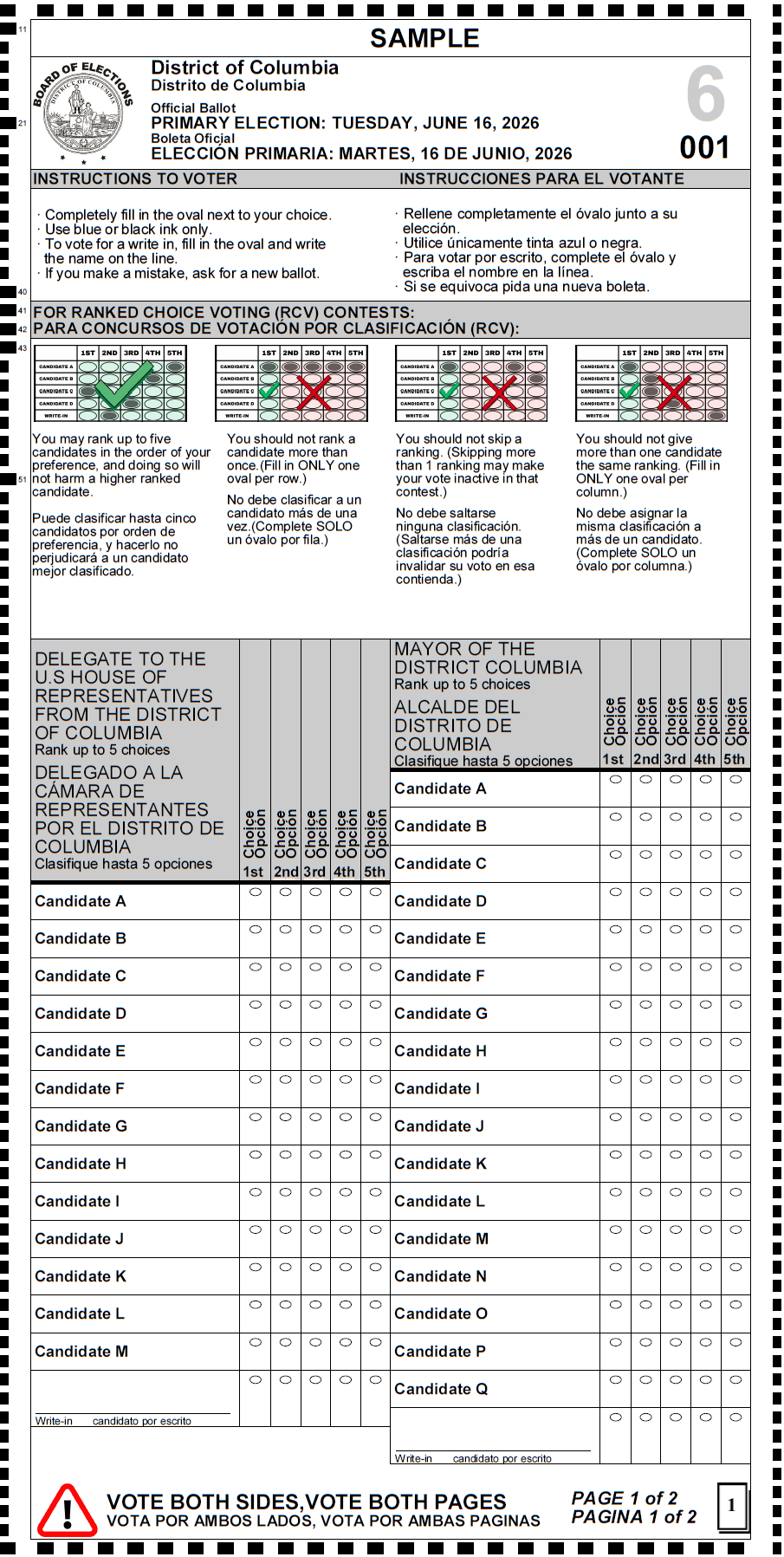
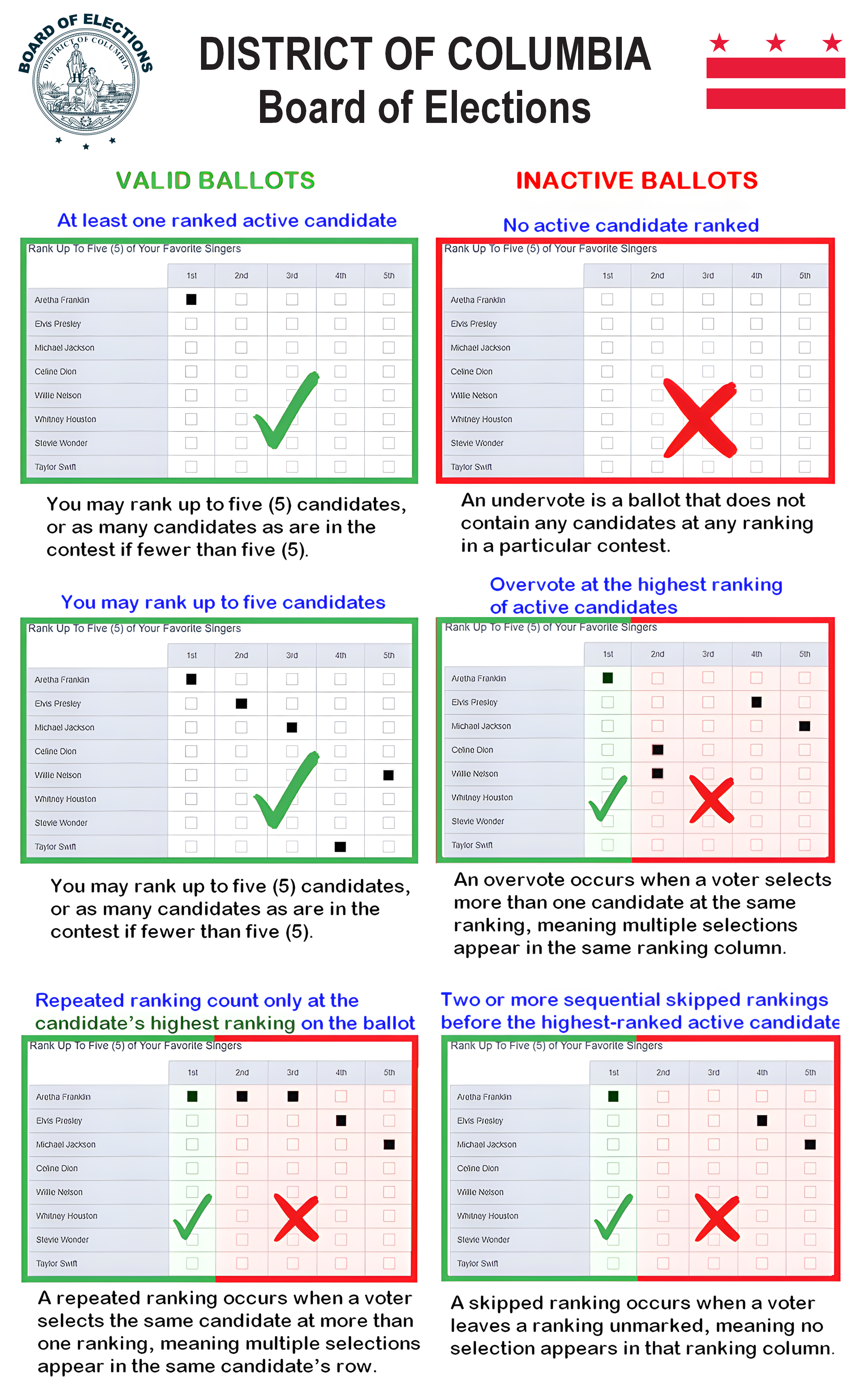
| SAMPLE RCV BALLOT | RCV VIDEOS | VALID & INACTIVE RCV SCENARIOS |
 |       |  |
LET'S RANK DC's FAVORITE ICE CREAM FLAVORS!
(After voting, click on PRELIMINARY RESULTS to see the RCV tabulation process)

Frequently Asked Questions (FAQs)
OVERVIEW
Ranked Choice Voting (RCV) - What is it?
Ranked choice voting (RCV) is a voting method in which voters rank candidates in order of preference (1st choice, 2nd choice, 3rd choice, 4th choice, 5th choice). Beginning with the June 2026 Primary Election in DC, ranked choice voting will be used in eligible contests with three or more candidates.
RCV allows your vote to count towards another candidate if your 1st choice candidate receives the fewest votes.
Why does DC use RCV?
In 2024, DC voters supported a ballot initiative that would implement RCV in the District of Columbia. The DC Council funded RCV in the FY2026 budget.
ELIGIBLE CONTESTS
Who is elected using RCV?
In DC, RCV is used in the following contests if there are three or more candidates on the ballot:
- President and Vice President of the United States;
- Mayor of the District of Columbia;
- Attorney General;
- Chairman of the Council of the District of Columbia;
- Delegate to the United States House of Representatives;
- Members of the Council of the District of Columbia;
- Members of the State Board of Education;
- United States Senator;
- United States Representative; and,
- Advisory Neighborhood Commissioner.
RANKING CANDIDATES
How many candidates can I rank?
In eligible contests with three or more candidates, voters may rank up to five candidates, including write-in, or as many candidates as there are in the contest if fewer than five.
Am I required to rank candidates?
No. You can still vote for your 1st choice candidate. However, ranking other candidates does not harm your 1st choice.
If I rank multiple candidates, does that mean I voted multiple times?
No. Only one vote counts per race. Your 2nd (or later) choice will only be considered if your 1st choice fails to get enough votes and is eliminated.
What happens if there is a tie?
It is extremely unlikely that a ranked choice election will end in a tie. However, if there is a tie at any step of the process, it will be decided “by lot”, which means the Chairperson of the Board of Elections (or designee) will flip a coin.
What are the rules for ranking candidates?
You should not give multiple candidates the same ranking, rank a candidate more than once, or skip a ranking (i.e., rank 1, 3, but skip 2).
BALLOTS
How do I complete a ranked choice ballot?
With RCV, voters can rank up to five candidates in order of preference. As a voter, you should:
- Pick your 1st choice candidate and completely fill in the oval next to their name under the 1st column.
- If you have a 2nd choice candidate, fill in the oval next to their name under the 2nd column.
- If you have a 3rd choice candidate, fill in the oval next to their name under the 3rd column.
- Rank up to five candidates, including write-ins, using this method.
- Ranking other candidates does not affect your first choice or decrease the odds of your first choice winning.
- You do not have to rank every candidate
TABULATION OF VOTES
How are votes tabulated with RCV?
RCV is used for eligible contests with three or more candidates. During tabulation, all 1st choice candidate votes are counted. If no candidate or candidates (in contests where voters choose two winners) reach the required percentage of votes to win, the candidate with the fewest votes is eliminated.
Votes from this eliminated candidate are then transferred to the 2nd choice candidates on a voter’s ballot. This process continues until a candidate or candidates reach the required percentage of votes to win.
How are votes tabulated for particular contests?
Votes are tabulated for particular contests using the following steps:
- For contests other than a general election for at-large members of the Council of the District of Columbia and any presidential preference primary election:
- All 1st choice candidate votes are tabulated.
- If any candidate receives a majority of votes, they are declared the winner.
- If no candidate reaches a majority of votes, the candidate with the fewest votes is eliminated, and votes from the eliminated candidate are then transferred to the voters’ 2nd choice candidates.
- This process continues until a single candidate receives the majority of votes.
- For a general election contest for at-large members of the Council of the District of Columbia, where two winners are declared,
- Each ballot counts as one vote for the highest-ranked candidate on that ballot.
- Tabulation shall then proceed in rounds until there are two candidates remaining.
- If there are more than two candidates with votes remaining, the candidate with the fewest votes is eliminated, and the votes from the eliminated candidate are transferred to the ballot's next-ranked remaining active candidate.
- This process continues until two candidates remain, and they will be declared winners.
- In any presidential preference primary election in which delegates are awarded to multiple candidates on a proportional basis,
- Each ballot counts as one vote for the highest-ranked active candidate on that ballot. Tabulation shall proceed in rounds.
- If the percentage of total votes cast for a candidate is above the party's threshold for receiving delegates, the candidate is declared the winner.
- If there are active candidates whose percentage of the vote total is below the party's threshold for receiving delegates, the candidate with the fewest votes is eliminated, and the ballot’s votes are then transferred to the ballot's next-ranked remaining active candidate.
- This process continues until the required number of candidates remain, and they will be declared winners.
- For this contest, a political party may also allocate delegates in accordance with its own party rules.
ELECTION RESULTS
When can I expect results in RCV elections?
Final results in ranked choice elections will not be known until all eligible ballots have been received and counted. In DC, mail-in ballots are accepted by the DC Board of Elections up to 10 days after the election, if the ballots are postmarked by Election Day
PRINTABLE DOCUMENTS
- RANKED CHOICE VOTING FAQs
- Also in አማርኛ 中文 Français 한국어 Español Tiếng Việt
- RANKED CHOICE VOTING PALMCARD
- Also in አማርኛ 中文 Français 한국어 Español Tiếng Việt
You can also practice RCV in person at DCBOE's office. Call (202) 727-2525 to schedule an appointment.